
Most computer science courses teach you to work with neat, organized databases. Rows and columns. Tables with relationships. SQL queries that return exactly what you need. Then you get your first job and realize 80% of real-world data looks nothing like that.
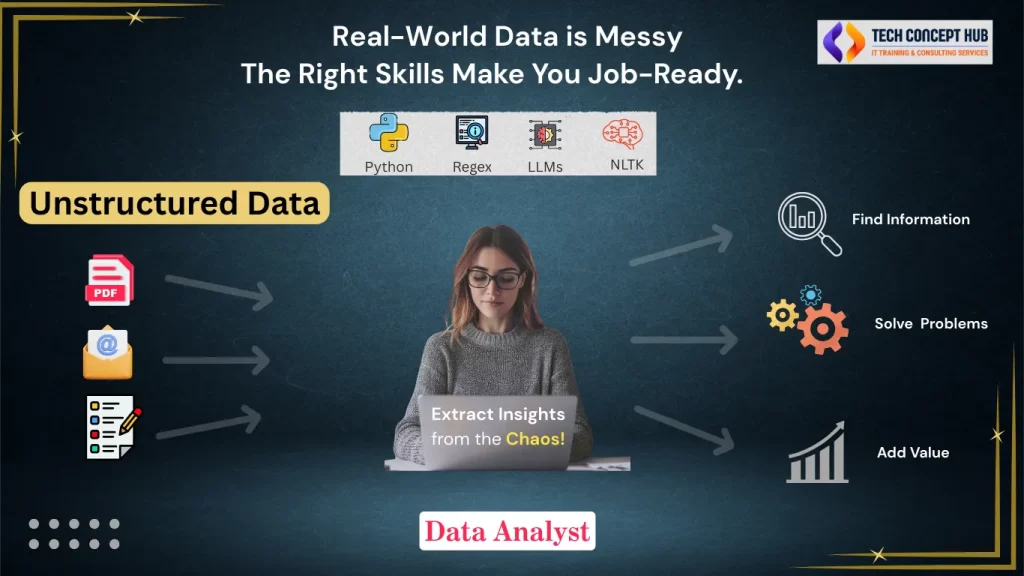
What They Don’t Teach You in College
We spent four years learning about normalized databases, efficient queries, and data structures. First week on the job, someone handed us a folder with 500 PDF invoices and said “extract the important information from these.”
No tables. No schema. Just documents written by different people, in different formats, with information scattered randomly across pages.
That’s unstructured data, and it’s everywhere.
What Unstructured Data Actually Looks Like
Forget the textbook definition for a second. Here’s what unstructured data really is:
Emails where the same information appears in different places depending on who wrote it. One person puts the order number in the subject line. Another buries it three paragraphs down. Some don’t include it at all.
PDF documents where tables aren’t actually tables – they’re just text formatted to look like tables. Try copying data from a PDF sometime. Half the time the columns get mixed up.
Customer feedback that ranges from “great product!” to three-paragraph essays about shipping experiences, mixed with complaints about things completely unrelated to what you’re analyzing.
Images and scans of forms where people’s handwriting turns your perfect OCR system into a guessing game.
Chat logs where conversations jump between topics, include typos, use abbreviations, and somehow still need to be analyzed for customer insights.
The common thread? There’s no predetermined structure. No guaranteed format. No schema telling you where to find what.
Why This Matters More Than You Think
Here’s something we noticed while hiring: fresh graduates can write complex SQL queries and design elegant database schemas. Great skills, absolutely useful.
But show them a pile of unstructured documents and ask them to extract insights? Most freeze up. They’re waiting for someone to clean the data first, organize it, put it in a database.
That’s not how real work happens.
Companies are drowning in unstructured data. Customer emails, scanned contracts, social media comments, PDF reports, support tickets, meeting transcripts. All valuable. None of it in a neat database.
The people who can handle this mess? They’re not just valuable – they’re essential.
The Real Challenge (Nobody Talks About This)
Working with unstructured data isn’t really about technical skills. Sure, you need to know some tools, but that’s not the hard part.
The hard part is dealing with inconsistency.
Let’s say you’re extracting dates from documents. In structured data, dates are in a date field, formatted consistently. Done.
In unstructured data:
- “Jan 15, 2024”
- “15/01/2024”
- “January 15th, 2024”
- “2024-01-15”
- “01-15-24”
- “the fifteenth of January”
All the same date. Six different formats. And that’s before someone writes “next Tuesday” or “two weeks from now.”
Or extracting prices:
- “$1,234.56”
- “1234.56 USD”
- “$1234.56 (including tax)”
- “Total: 1,234 dollars and 56 cents”
- “Price is $1K approximately”
Same information, completely different representations.
This is why working with unstructured data is actually harder than most people expect. It’s not about writing code – it’s about anticipating chaos.
Tools We Actually Use
Forget the comprehensive list of every tool ever made. Here’s what we actually use regularly:
Python libraries like PyPDF2, pdfplumber, or PyMuPDF for extracting text from PDFs. Each has different strengths. None of them work perfectly on every PDF.
Regular expressions (regex) for finding patterns in text. This is non-negotiable. If you can’t write regex, you’ll struggle with unstructured data. Period.
Pandas for organizing the mess once you’ve extracted it. Even unstructured data needs structure eventually.
spaCy or NLTK for natural language processing when you’re dealing with actual written text and need to understand context.
OpenCV or Tesseract if you’re working with images or scanned documents. OCR is its own special kind of chaos.
OpenAI or similar LLMs have become surprisingly useful for extraction tasks. Sometimes the best way to handle inconsistency is to use something that actually understands language.
But honestly? The tool matters less than understanding what you’re trying to do.
What We Learned the Hard Way
Assumption 1: “I’ll just clean all the data first, then process it”
Doesn’t work. Unstructured data is messy by nature. You can’t clean everything upfront because you don’t know what “clean” looks like until you see all the variations.
Better approach: Process it, see what breaks, handle those cases, repeat. It’s iterative.
Assumption 2: “I’ll write one script that handles everything”
Nope. You’ll end up with unmaintainable spaghetti code full of special cases and exceptions.
Better approach: Build small, focused functions that handle specific types of inconsistency. Combine them as needed.
Assumption 3: “Once I handle these edge cases, I’m done”
There are always more edge cases. Always. Someone will send you a document scanned upside down. Or in a format you’ve never seen. Or with handwritten notes in the margins that your OCR tries to process.
Better approach: Build systems that fail gracefully and log errors so you can fix them later.
A Real Example (Simplified)
We once needed to extract invoice amounts from hundreds of PDF invoices. Sounds simple, right? Find the total, grab the number.
Here’s what we actually encountered:
Some invoices had “Total: $5,000” Others had “Amount Due: 5000.00 USD” Some had multiple totals (subtotal, tax, grand total) A few had the total in a table Several had handwritten totals because someone changed the price A couple were scanned sideways One was in French
Our first attempt: Look for the word “total” and grab the number after it. Success rate: About 40%
Our second attempt: Look for multiple keywords, find numbers near them, apply some logic to pick the right one. Success rate: About 70%
Our third attempt: Use OCR to find all numbers, use an LLM to identify which one was most likely the invoice total based on context. Success rate: About 92%
We never hit 100%. And that’s okay. The point is handling as many cases as possible and flagging the rest for human review.
What Employers Actually Want
Here’s what hiring managers told us when we asked why they value this skill:
“Most candidates can write code. Few can deal with messy real-world data.”
“We have ten years of documents to digitize. We need someone who won’t give up when it’s not perfectly formatted.”
“Our customers send us data in every format imaginable. We need people who can handle that.”
Every company has unstructured data problems. Most are sitting on valuable information they can’t access because nobody knows how to extract it efficiently.
If you can walk into an interview and say “I’ve worked with messy PDFs, inconsistent text data, and built systems to extract information from them” – you stand out immediately.
How to Actually Learn This
Forget online courses for a minute. Here’s how to build real skill:
Find a messy dataset. Kaggle has some, but better yet, create your own. Download 50 random PDFs from the internet. Try to extract specific information from them. You’ll hit every problem imaginable.
Build something that breaks. Seriously. Write a script to extract emails from text. Watch it fail on edge cases. Fix those cases. Watch it fail on new edge cases. That’s learning.
Work with real documents. Restaurant menus, resumes, invoices, receipts. Each type has its own chaos. Each teaches you something different.
Learn regex properly. Not just basic patterns – learn lookaheads, lookbehinds, non-capturing groups. Regex is your best friend with unstructured data.
Practice OCR. Find scanned documents, run them through Tesseract, cry at the results, figure out how to improve them. That’s the cycle.
Use LLMs for extraction. Try using GPT to extract information from messy text. Compare results with traditional methods. Understand when each approach works better.
Project Ideas That Actually Build Skills
Resume parser: Extract name, email, education, experience from resumes. People format resumes in wildly different ways. Great learning experience.
Receipt scanner: Take photos of receipts, extract store name, date, items, total. Real-world OCR challenges with actual consequences if you get it wrong.
Email analyzer: Parse emails to categorize them, extract action items, identify urgency. Teaches you to handle natural language variation.
Document converter: Take messy PDFs, extract tables, convert to structured CSV. You’ll encounter every PDF nightmare that exists.
Social media scraper: Collect posts, clean the text, extract mentions/hashtags, categorize sentiment. Teaches you to handle really messy text data.
The Uncomfortable Truth
You won’t master unstructured data through tutorials. You can’t. There are too many edge cases, too many variations, too many “it depends” situations.
You master it by failing repeatedly. By building something that works on 10 examples, then breaks on the 11th. By spending hours debugging why your regex works on everything except that one weird document.
That’s frustrating. It’s also how you actually learn.
The good news? Most people give up when things get messy. If you push through the frustration and build systems that handle real-world chaos, you’ve already separated yourself from 80% of other candidates.
The Bottom Line
Structured data skills get you in the door. Database design, SQL, data modeling – all important, all teachable, all well-covered in courses.
Unstructured data skills make you valuable. Most companies have more unstructured data than structured. Most are struggling to make use of it. Most need people who can handle the mess.
Learn to work with PDFs that don’t cooperate. Text that’s inconsistent. Images that OCR poorly. Documents that follow no standard format.
Build systems that extract value from chaos. That’s not just a nice skill to have – that’s what makes you job-ready in the real world.
Start with one messy data source. One extraction task. Get it working. Then make it handle edge cases. Then move to something harder. Repeat until dealing with chaos feels normal.
That’s when you know you’ve got it. And that’s when you become the person companies actually need, not just another candidate who knows SQL.