
A Guide For Students Looking for Job after BA in Sociology.
In today’s fast-changing world, understanding people, culture, and societies has become more important than ever. Sociology the scientific study of society, human behavior, and social institution-offers valuable insights into how communities’ function, evolve, and respond to change. But beyond the classroom, what does a career in sociology really look like? Let’s explore the scope & opportunities after pursuing sociology.
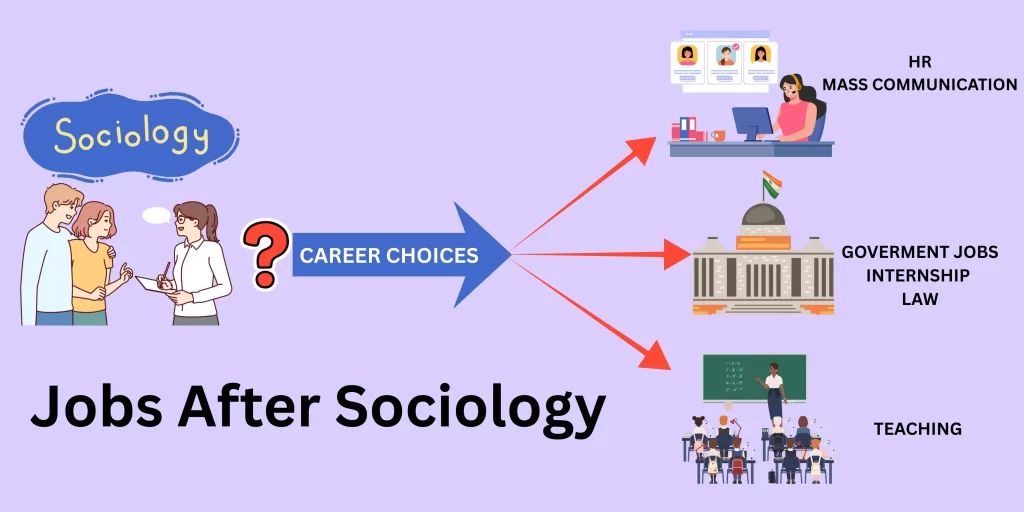
Where Can You Find Jobs after Sociology?
Government Sector: UPSC, State PSC, Social Welfare Departments, and Urban Development Authorities. You can find on:
https://services.india.gov.in/service/ministry_services?ln=en&cmd_id=1630
Private Sector: HR departments, marketing firms, CSR (Corporate Social Responsibility) divisions, data analytics companies. You can find on:
Non-Governmental Organizations (NGOs): UN agencies, UNICEF, CRY, Teach For India, and other social development bodies.You can find on:
https://niti.gov.in/work-niti/vacancy-circular
https://www.pmc.gov.in/en/l/recruitment
Academic Institutions: Schools, colleges, and universities offering sociology or social science programs.You can find on:
Research Institutes: Centre for the Study of Developing Societies (CSDS), NCAER, TISS, and others.You can find on:
https://www.researchgate.net/search
With the growing importance of data-driven and socially conscious decision-making, sociology graduates have a wide range of opportunities to shape society and contribute meaningfully to the world.
Career Scope After Sociology
The scope of sociology extends across government, private, and non-profit sectors. Sociologists can work in research, education, social services, human resources, urban development, and more. The key lies in applying sociological knowledge to practical, real-world situations.
Below are some of the most promising career options:
1. Social Researcher
Where to work: Research institutes, NGOs, government agencies, or think tanks.
What you’ll do: Collect and analyze data on social trends, public behavior, and policy outcomes. Your research may influence government programs, education systems, or urban planning.
Skills needed: Data analysis, fieldwork, report writing, and critical thinking.
2. Policy Analyst
Where to work: Government ministries, advocacy organizations, or consulting firms.
What you’ll do: Analyze social policies related to health, education, gender, or housing. Suggest improvements and assess their social impact.
Skills needed: Policy research, data interpretation, communication, and socio-economic understanding. Masters is mandatory for working as policy analyst.
3. Human Resource Executive
Where to work: Corporate companies, HR consultancies, start-ups.
What you’ll do: Apply your understanding of human behavior to recruit, train, and manage employees effectively.
Skills needed: Interpersonal communication, organizational behavior, ERP knowledge.
4. Urban Planner / Development Officer
Where to work: Municipal corporations, housing boards, or urban development NGOs.
What you’ll do: Work on city planning, public space design, and community development projects. Sociology provides a people-centric perspective to planning.
Skills needed: Project management, demographic analysis, and planning research.
5. Social Worker or NGO Professional
Where to work: Non-profits, community organizations, welfare departments.
What you’ll do: Work directly with communities to address issues like education, child welfare, women empowerment, or poverty alleviation.
Skills needed: Empathy, field experience, Communication and project coordination.
6. Market Research Analyst
Where to work: Marketing firms, advertising agencies, corporate research departments.
What you’ll do: Study consumer behavior, social trends, and brand perception. Sociology helps you understand how social factors influence buying decisions.
Skills needed: Statistical tools, survey design, and analytical thinking.
7. Academic and Teaching Career
Where to work: Schools, colleges, universities, or online education platforms.
What you’ll do: Teach sociology or social sciences, conduct research, and publish academic papers.
Skills needed: Subject expertise, presentation skills, and research aptitude. Candidate needs to clear NET-SET certification exam.
8. Journalism and Media
Where to work: News organizations, content firms, digital media companies.
What you’ll do: Write or report on social issues, culture, and human-interest stories.
Skills needed: Writing, research, and understanding of social narratives.