
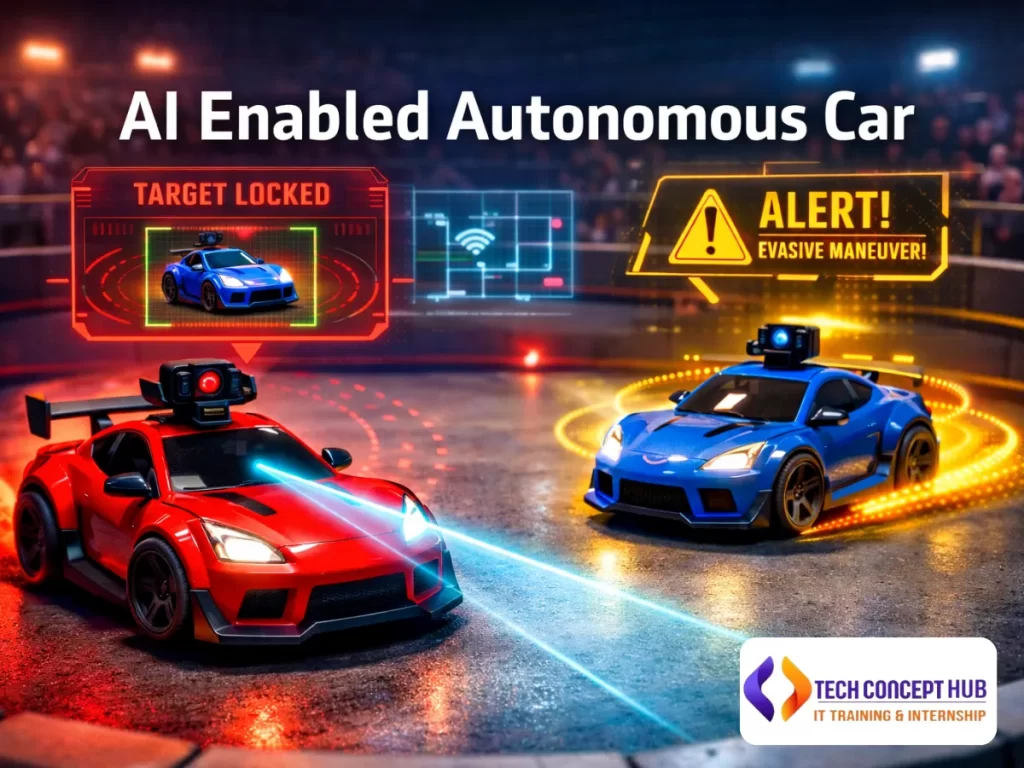
Imagine an arena where two autonomous toy cars compete in a real-time intelligence challenge.
One car plays the role of the Hunter, whose objective is to detect and catch the other car. The second car acts as the Escape Artist, constantly monitoring its surroundings and making intelligent decisions to avoid being captured.
Both cars operate under identical physical conditions—they have the same speed, same hardware capabilities, and the same movement constraints. The outcome depends entirely on their ability to detect faster, think smarter, and react more efficiently using Artificial Intelligence.
This challenge demonstrates how AI enables machines to perceive their environment, make decisions, and act autonomously in dynamic situations.
Core Objectives
1. Autonomous Detection
Each car must be capable of detecting the other in real time.
Possible detection methods include:
Camera-based detection (Computer Vision):
Using onboard cameras combined with AI models to visually identify and track the opponent.Distance sensors:
Such as ultrasonic, infrared, or LiDAR sensors to detect nearby objects and measure distance.Signal-based detection:
Using Bluetooth, Ultra-Wideband (UWB), or RF signals to estimate relative position.
The faster and more accurately a car detects its opponent, the greater its strategic advantage.
2. Autonomous Decision-Making
Both cars must operate completely autonomously without any manual intervention.
The Hunter car continuously analyzes the opponent’s position and predicts the best path to intercept.
The Escape car detects approaching threats and calculates the optimal direction to maximize distance and avoid capture.
These decisions must be made using AI algorithms running onboard in real time.
3. Intelligent Movement and Turning
Each car has full freedom to move and turn within the arena.
Key capabilities include:
Real-time path planning
Dynamic obstacle avoidance
Fast directional adjustments
Efficient motion control
The winner will be the car that demonstrates superior reaction time, prediction, and movement strategy.
4. Boundary Awareness
The arena represents a fixed environment.
Both cars must:
Detect arena boundaries
Avoid crossing outside the permitted area
Adjust their path intelligently while maintaining their objective
This requires environmental awareness and spatial intelligence.
5. Fully Autonomous AI System
This is a complete AI-Enabled autonomous toy car, where:
No human intervention is allowed
No remote control is used
All decisions are made by onboard AI models
Cars continuously perceive, decide, and act independently
This setup simulates real-world autonomous systems such as:
Self-driving cars
Autonomous robots
Military defense drones
Industrial automation robots
What This Demonstrates
This challenge is not just a game—it is a powerful demonstration of real AI capabilities, including:
Computer Vision
Real-time decision making
Reinforcement learning
Autonomous navigation
Edge AI deployment
Robotics intelligence
It highlights how machines can compete using intelligence, not hardware advantage.
The Ultimate Question
Since both cars have equal speed and equal hardware, the winner will be determined entirely by:
Detection speed
Decision intelligence
Prediction accuracy
Movement efficiency
In this arena, intelligence wins—not speed.