
Over the years, Robotic Process Automation (RPA) has helped organizations in eliminating repetitive tasks, driving productivity targets and digitalization initiatives. Now, with advances in AI technologies like Gen AI and AI Agents, organizations are looking to move from Automated processes towards autonomous enterprise. There is a need of new role like Agentic/Gen AI Engineer, AI Systems Architect and AI Systems Consultants. For RPA developers, this shift is not a disruption but it is more of a natural evolution.
At its core, traditional RPA focuses on rule-based execution. Developers design bots that follow predefined steps using deterministic logic (if else and looping conditions). While effective with stable and repetitive processes, these bots struggle when faced with ambiguity, changing inputs, or unstructured data. Agentic AI systems address these limitations by operating on goals rather than scripts, enabling automation that can reason, adapt, and self-correct.
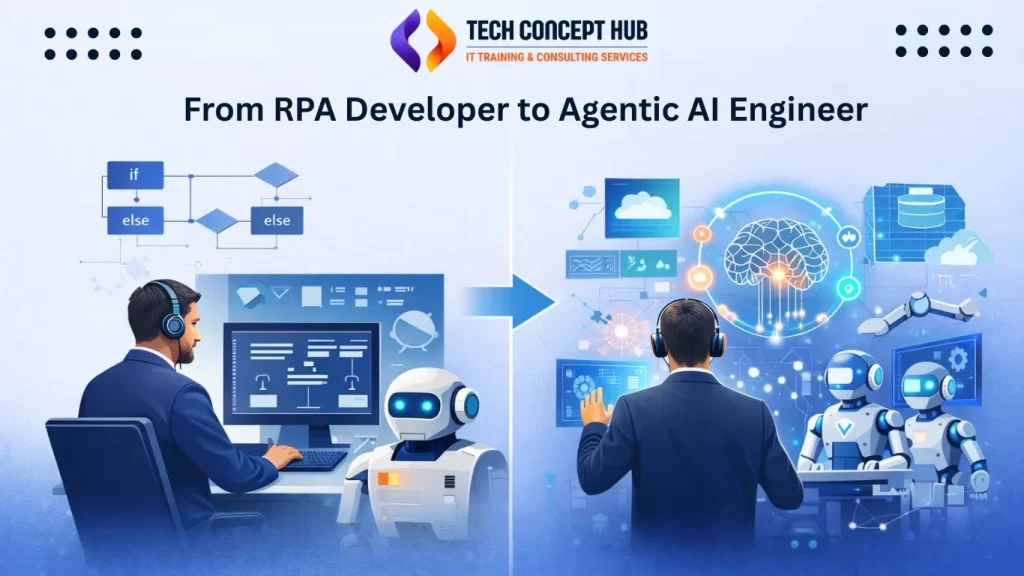
Shift from rule based to intelligent automation:
The first major transition is from process analysis to goal-oriented reasoning. Instead of mapping every step in a workflow, Agentic AI engineers define objectives, constraints, and success criteria. Using LLM-powered planning techniques, agents dynamically break down tasks and choose the best execution path based on context.
Another key shift is from if–else logic to probabilistic decision-making. RPA bots execute predictable outcomes, while AI agents evaluate uncertainty and make informed decisions using contextual understanding (somewhat like solving a sudoku puzzle). This allows agents to handle unexpected / unhandled scenarios, incomplete information, and natural language inputs with confidence.
Automation itself also evolves—from bots and workflows to autonomous agents. Agents can use tools, call APIs, maintain memory, and collaborate with other agents. Exception handling becomes smarter. Instead of routing failures to human operators, agents reflect on errors, retry with improved strategies, or escalate intelligently to humans if required.
UI-based automation gives way to API-first and tool-based execution, making systems more reliable and scalable. Orchestration of bots expands into multi-agent coordination, where specialized agents autonomusly plans, executes, validates, and monitors tasks together. Finally, bot / audit logs and execution history are replaced with AI observability and governance, ensuring transparency, compliance, and trust in autonomous systems.
From RPA Developer to Agentic AI Engineer
For RPA professionals, this transition is a powerful career upgrade. Skills in process thinking, orchestration, and enterprise automation provide a strong foundation. By adding AI reasoning, agent
We provide practical training in Agentic AI. This will help you transition your career from RPA to Agentic AI:
https://techconcepthub.com/agentic-ai-automation-course-syllabus/