
Build an application WhatsApp Chat Analyzer.
This should be an AI and NLP-based application that analyzes your WhatsApp chat history to uncover interesting behavioral, emotional, and social insights.
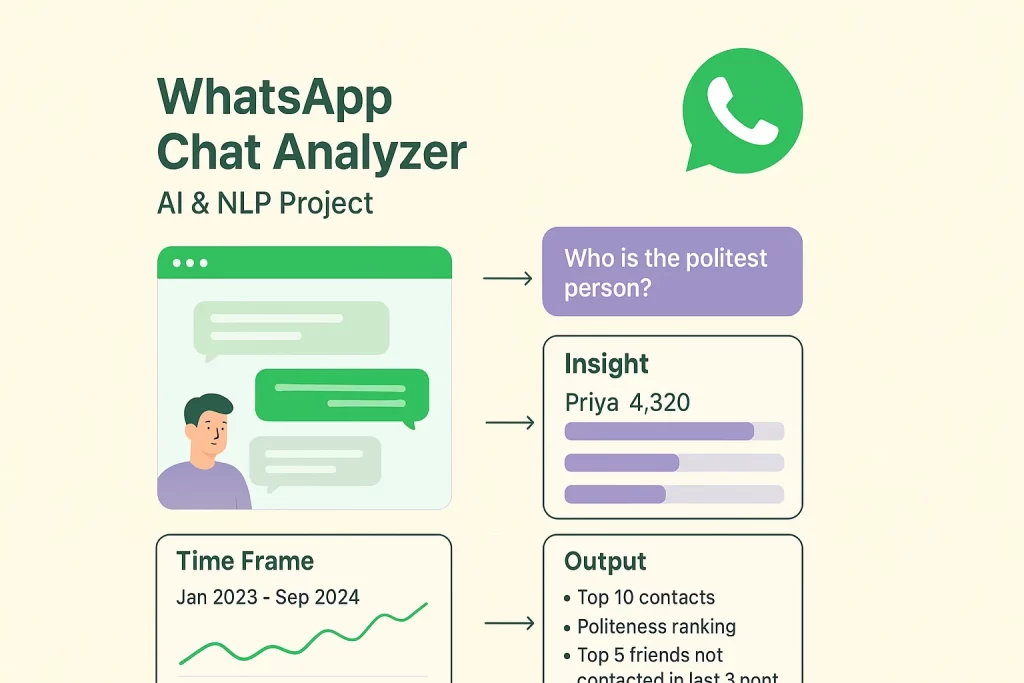
By using natural language processing and machine learning techniques, this application can automatically process your exported WhatsApp chats and answer questions like:
Who are your top 10 most-chatted contacts?
Which friend is the politest in your conversations?
Who haven’t you talked to in the last 3 months despite having a friendly relationship?
Which friend do you chat with the most overall?
When was your last trip, and who went with you?
The project helps learners explore text mining, sentiment analysis, relationship analytics, and question answering with NLP, using real-world unstructured chat data.
Project Objective
To build an AI-powered chat analytics tool that can:
Accept WhatsApp chat export files as input.
Analyze chats using data analytics and NLP techniques.
Provide interactive insights and reports over a selected time range.
Allow users to ask natural questions and get data-driven answers from chat history.
Key Features
1. Input Handling
Upload exported WhatsApp chat history (in
.txtformat).Automatically parse sender, date, time, and message text.
Handle both individual and group chats.
Normalize multilingual text (supporting English + Hinglish).
2. Time-Frame Filtering
Filter chats by From Year/Month → To Year/Month.
Example: Analyze chats only between Jan 2023 to Sep 2024.
3. Core Analytics Outputs
| Insight | Description |
|---|---|
| Top 10 contacts with maximum chats | Identify the most frequently messaged contacts. |
| Politeness ranking | Use NLP to measure politeness based on keywords like please, thank you, sorry, etc. |
| Top 5 friends not contacted recently | Detect contacts with high past engagement but no chat in last 3 months. |
| Highest chat volume contact | The person with whom total message count is highest. |
| Last trip and companion | Detect travel-related conversations and identify the friend mentioned in recent trip discussions. |
4. Question Answering (AI-Powered)
Users can ask natural questions like:
“Who do I message most on weekends?”
“Which friend uses the most emojis?”
“Who sends the longest messages?”
“What were my most discussed topics in 2024?”
The system uses LLM or Retrieval-based NLP models to search and answer queries directly from chat text.
How It Works (Step-by-Step)
1️⃣ Data Ingestion
Import exported WhatsApp
.txtfile.Parse messages using regex (sender, timestamp, message).
Convert to structured dataframe.
2️⃣ Data Preprocessing
Remove system messages (e.g., “You joined using this link”).
Clean emojis, stopwords, and punctuation.
Convert date/time fields into datetime objects.
3️⃣ Contact-Wise Aggregation
Group by contact name.
Calculate message counts, average message length, and sentiment.
Derive responsiveness and message exchange balance.
4️⃣ Politeness Analysis
NLP-based rule: Count words like please, sorry, thank you per contact.
Optionally train a small text classifier for polite vs impolite sentences.
5️⃣ Friendship Strength Scoring
Combine metrics such as:
Message frequency
Sentiment consistency
Duration of chat relationship
Emoji usage
to create a “Friendship Strength Index”.
6️⃣ Trip Detection
Use keyword-based topic modeling (LDA / BERTopic) with words like trip, travel, Goa, flight, hotel.
Detect the last date such keywords appeared and extract friend name(s) in that context.
7️⃣ Question Answering
Use NLP-based retrieval (TF-IDF / Sentence Embeddings) or LLM (GPT or open-source) to interpret user questions.
Map question intent → relevant dataset field → generate contextual answer.
Technology Stack
| Language | Python |
| Data Processing | Pandas, Regex, Numpy |
| NLP Processing | NLTK, spaCy, Transformers (Hugging Face) |
| Sentiment & Emotion Analysis | TextBlob, VADER, BERT Sentiment Models |
| Topic Modeling | LDA, BERTopic |
| Question Answering | OpenAI API, LangChain, or Haystack |
| Visualization | Streamlit / Plotly Dashboard |
| PDF / Report Generation | ReportLab / pdfkit |
Learning Outcomes
By completing this project, learners will:
✅ Understand real-world NLP preprocessing of conversational text.
✅ Learn to extract semantic and behavioral insights from unstructured data.
✅ Implement sentiment, politeness, and topic modeling techniques.
✅ Build an AI chatbot-style question answering system over personal data.
✅ Develop a Streamlit dashboard for interactive visualization and PDF reporting.
Example Outputs
📈 Top 10 Contacts by Chat Volume
| Rank | Contact | Messages | Last Active |
|---|---|---|---|
| 1 | Priya | 4,320 | Oct 2025 |
| 2 | Rohan | 3,980 | Sep 2025 |
| 3 | Neha | 2,700 | Oct 2025 |
| … | … | … | … |
😊 Politeness Leaderboard
| Rank | Contact | Politeness Score |
|---|---|---|
| 1 | Saurabh | 0.92 |
| 2 | Meenal | 0.89 |
| 3 | Aditi | 0.83 |
🧳 Last Trip Detected
“Trip to Goa with Rohan and Meenal on 15 March 2024.”
Conclusion
The WhatsApp Chat Analyzer project transforms casual conversations into powerful insights using AI and NLP.
It’s a perfect real-world project for learners to practice:
Data preprocessing
Text analytics
Sentiment modeling
Interactive visualization
Question answering
This project doesn’t just analyze text — it helps you learn practical challenges in developing real world applications.
Unlock the power of Artificial Intelligence with our Generative AI Course — designed for learners who want to master the latest AI technologies shaping the future. In this hands-on program, you’ll work on real-world projects like WhatsApp Chat Analyzer, SmartFinance Insight, and other innovative AI applications that combine machine learning, NLP, and data analytics. You’ll also explore cutting-edge tools like ChatGPT, Stable Diffusion, and LLM fine-tuning while learning prompt engineering and AI model deployment. Enroll today and become a certified Generative AI professional ready to lead the next wave of innovation!